AU





Conners Comprehensive Behavior Rating Scales 2nd Edition [CONNERS-CBRS2]
Designed to identify and assess behavioural, emotional, social, and academic difficulties in children and adolescents aged 6–18.
For ages: Parent & Teacher – 6 to 18, Self Report (Child) – 8 to 12, SelfReport (Adolescent) – 13 to 18
Administration Type: Parent, Teacher, SelfReport Child, SelfReport Adolescent
Administration Time: Parent 28mins, Teacher 23mins, SelfR Child 26mins, SelfR Adolescent 23mins
Format: Online administration and scoring in MHS Assessment Centre+ (MAC+); Print paper forms and score online
Author: C. Keith Conners, PhD.
Online Forms, Reports, Kits & e-Manuals
All online resources including Forms, Reports, i-Admins, Kits and e-Manuals.
Conners CBRS 2nd Edition Online Report (each)
The Conners Comprehensive Behavior Rating Scales™ 2nd Edition (Conners CBRS® 2) is a comprehensive broadband assessment of behavioral, emotional, social, and academic concerns and disorders, as well as strengths, in children and adolescents aged 6 to 18 years. The Conners CBRS 2 provides a structured, evidence-based view of functioning across Parent, Teacher, and Self-Report perspectives. Built on decades of research and updated to reflect current diagnostic frameworks, this multi-rater assessment helps qualified professionals move efficiently from broad concerns to confident next steps.
Features
- Improved alignment across Parent, Teacher, and Self-Report forms, enabling more direct comparison of information from different informants
- Revised item content informed by advances in youth mental health research, with input from language experts to improve clarity, cultural sensitivity, and fairness across diverse populations.
- Content and DSM Symptom Scales are now organized into four clinically meaningful domains (Strengths, Neurodevelopmental, Externalizing, and Internalizing) to help identify broader patterns in a youth’s behavior and functioning.
- New and expanded Content Scales including Resilience, Social Skills, Disinhibition, Aggression, and Callousness.
- Updated DSM Symptom Scales aligned to current DSM-5-TR criteria.
- Updated Clinical Indicator Items now include Disruptive Mood Dysregulation Disorder, Risky Behaviors, Eating Disorder, and Problematic Internet Use.
- Expanded Impairment & Functional Outcome Items now capture impairment across five areas of functioning.
- Self‑Report form has been split into two age‑specific versions: Self-Report–Child (ages 8–12) and Self-Report–Adolescent (ages 13–18).
- Expanded Response Style Analysis, including revised Inconsistency Index and Negative Impression Index, a new Omitted Items indicator, and a new Pace indicator for online administrations.
- Updated normative data from diverse U.S. and Canadian samples, stratified by key demographic variables to reflect national populations.

Reports
The Conners CBRS 2 provides a Single-Rater Report that presents detailed information about scores from a single administration. The report compares a youth’s scores to an age-based normative sample, identifies elevated scores at both the scale and item level, presents results both numerically and graphically, and includes recommendations for areas that may warrant further investigation.
Reliability, Validity, and Fairness
Reliability
The Conners CBRS 2 demonstrates strong reliability across raters, scales, and time, supporting consistent interpretation of results.
- Excellent internal consistency across Parent, Teacher, and Self-Report forms, with median alpha coefficients ranging from .86 to .90.
- Strong test-retest reliability, with scores remaining stable over a 2- to 4-week interval, with median correlations ranging from .70 to .87.
- Moderate to strong inter-rater agreement, reflecting expected variability across settings while supporting real-world clinical usefulness, with median correlations ranging from .59 to .79.
Together, these findings indicate that the Conners CBRS 2 scores are consistent, precise, internally coherent, and stable, providing a dependable foundation for decision-making.
Validity
Evidence supports the validity of the Conners CBRS 2 for assessing emotional, behavioral, and developmental functioning.
- Strong structural validity, with exploratory and confirmatory factor analyses confirming that scales align with the intended domain and content structure and fit the theoretical model well.
- Strong classification accuracy, with a median overall correct classification rate of 78.4% across rater forms and clinical groups.
- Strong convergent validity, demonstrated through moderate to high correlations with established measures, including the original Conners CBRS (median r = .73).
- Strong criterion-related validity, with youth from multiple clinical groups (i.e., Specific Learning Disability; Attention-Deficit/Hyperactivity Disorder; Autism Spectrum Disorder; Disruptive, Impulse-Control, or Conduct Disorder; depressive disorders; and anxiety disorders), showing clear and meaningful score differentiation from the general population in expected domains (median Cohen’s |d| = 0.98).

Fairness
The Conners CBRS 2 was developed and evaluated with a strong emphasis on delivering a fair and responsible assessment. Measurement invariance is supported across key demographic variables, including gender, race/ethnicity, parental education level, and country (U.S. vs. Canada).
Specifically, the Conners CBRS 2:
- Shows no gender-related measurement bias across rater forms, supporting the appropriate use of both Combined Gender and Gender-Specific Norms.
- Measures behavior and social-emotional functioning comparably across major racial and ethnic groups, with generally small score differences that align with prior research and indicate results are not driven by test bias.
- Yields Parent and Self-Report results that are consistent across parental education levels, with minimal score differences and no meaningful impact on interpretation.
- Functions similarly for youth in the U.S. and Canada, with highly similar scores supporting fair use and shared norms.
These results support consistent interpretation of scores across diverse populations, aligning with best practices for ethical and defensible assessment use.
Normative Data
The Normative Samples include 4,420 ratings of youth (Parent N = 1,560; Teacher N = 1,560; Self-Report N = 1,300). Participants were drawn from the United States (~90%) and Canada (~10%), reflecting their relative population sizes. Samples are balanced by age and gender and stratified to closely reflect recent census proportions for race/ ethnicity, parental education level, and geographic region (matching within 2%), as well as recent prevalence rates for select clinical groups. This representative foundation supports confident comparison of individual results to relevant peer groups.
Sample Reports
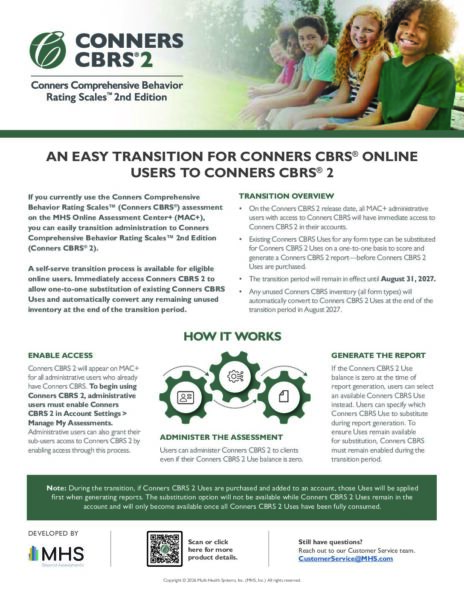 CBRS2_Transition_HUB_0726.pdf
 Download
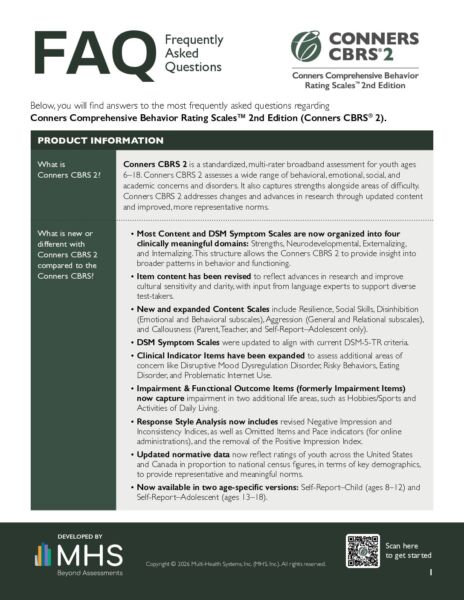 CBRS2_FAQ_HUB_0726 Download
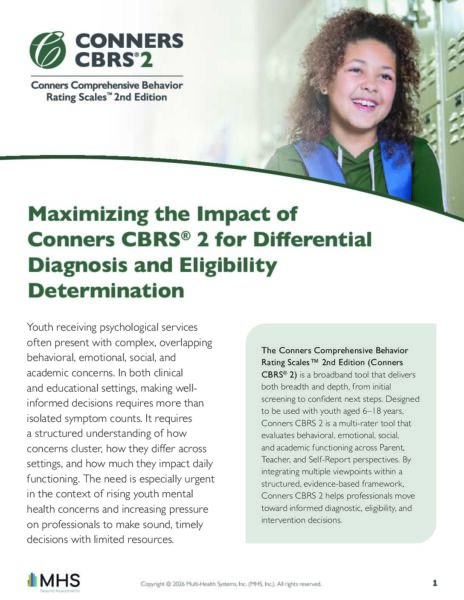 CBRS2_Differential_Diagnosis_and_Eligibility_Determination_HUB_0726.pdf Download
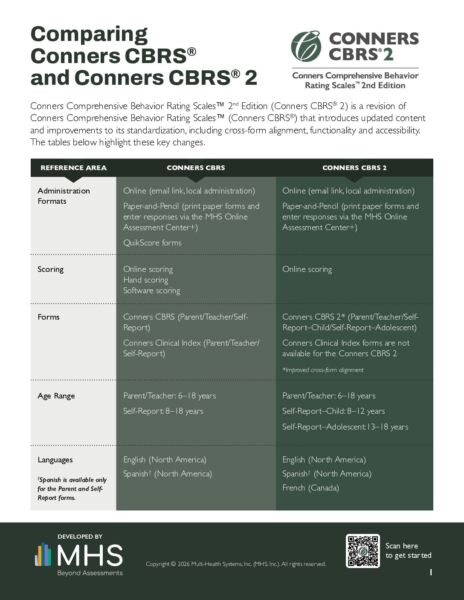 CBRS2_Comparison_HUB_0726 Download
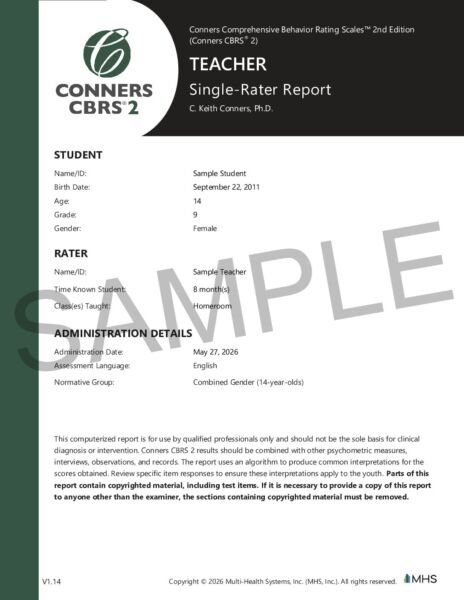 Conners_CBRS2_Sample_Report_Teacher_HUB_0826 Download
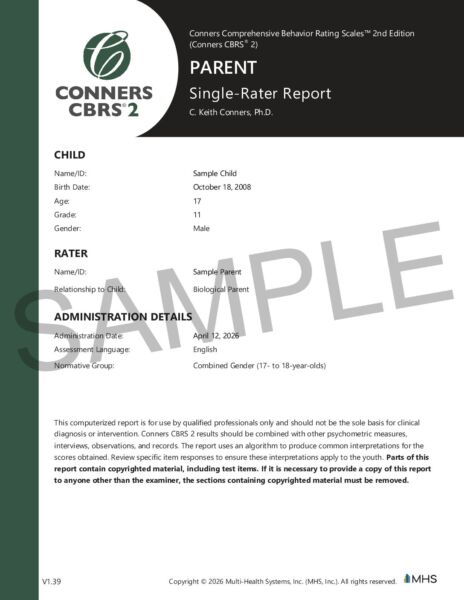 Conners_CBRS2_Sample_Report_Parent_HUB_0826 Download
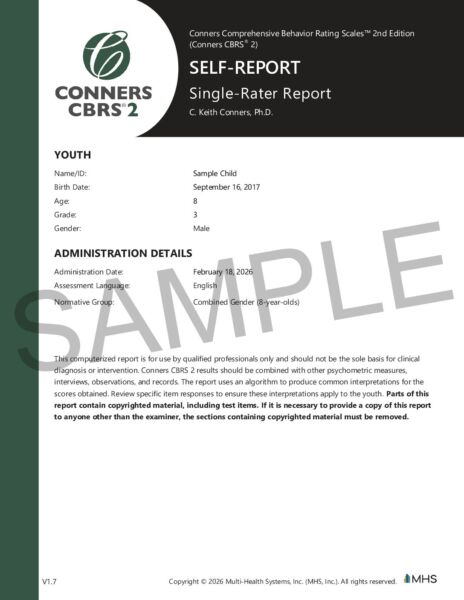 Conners_CBRS2_Sample_Report_Child_HUB_0826 Download
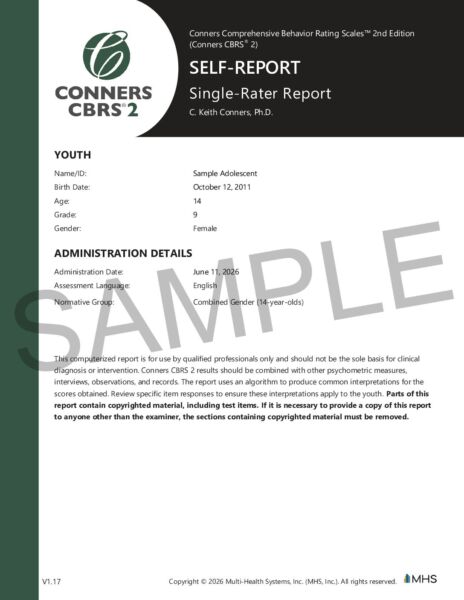 Conners_CBRS2_Sample Report_Self-Report_Adolescent_HUB_0826 Download